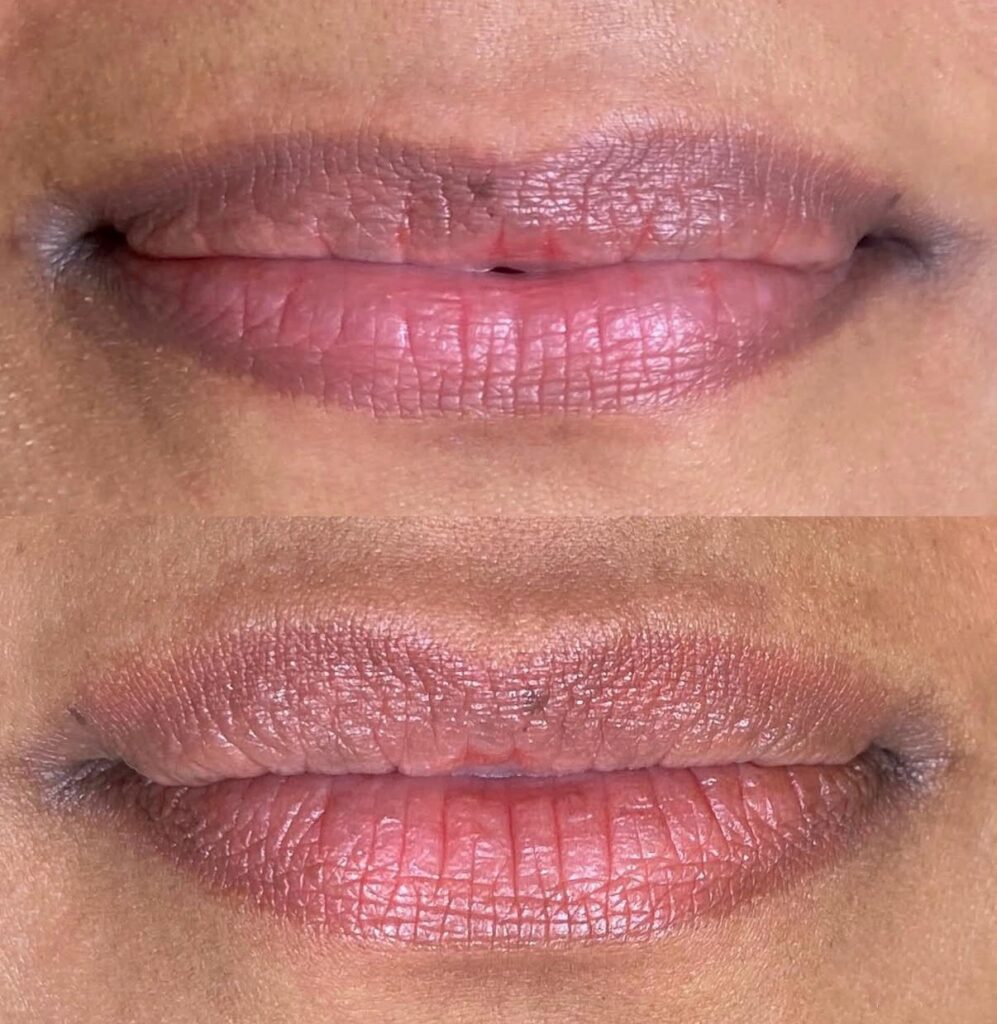
Lip blush and lip neutralisation are often talked about as though they are two versions of the same treatment. They are not.
Lip blush is designed to enhance the natural colour of the lips, while lip neutralisation is used when darker or uneven pigmentation needs to be balanced first. Which treatment is right for you depends on the colour already present in your lips, your natural undertones and how your lips are likely to heal.
To understand why, it helps to look at what gives your lips their natural colour in the first place.
The natural colour of your lips is made up of two things. The first is melanin, the pigment that determines how deep your natural tone is. The second is the network of blood vessels that sits very close to the surface, because lip skin is thin and lacks the protective layers found elsewhere on the face. This is why lips look pink in some people and cooler in others, and why many darker or uneven lips carry blue, purple or brown undertones. Cosmetic tattoo pigment does not sit on top of that colour like paint. It blends with it. Two people can have the same shade applied and heal to two quite different results, because each is blending with a different starting point. This is why we never work from a single standard shade.
Lip blush is a soft wash of colour that enhances the natural tone of the lips. It is not an opaque lipstick effect or a defined outline. It works with what is already there, restoring colour where it has faded, evening out mild differences in pigmentation and creating the appearance of more balanced, defined lips. On lips that are pale, faded or fairly even in tone, the colour has a clear place to settle, and the healed result is soft and natural.
Where the lips carry significant darker or uneven pigmentation, the picture changes. Pigmentation is the depth and evenness of colour already present in the lips. It may be genetic, or it can become more pronounced over time through factors such as sun exposure, hormonal changes, certain medications, smoking or previous irritation or inflammation of the skin.
A pink or nude lip blush colour placed directly over cooler, darker tones does not simply sit above them. The tones beneath show through, and the healed shade can appear muted, greyed or different from the one that was planned.
This is where lip neutralisation begins, and it draws on the same principle a makeup artist uses with a colour corrector. On a colour wheel, warm tones sit opposite cool ones. A warm corrective pigment, chosen for your undertone, is used to counterbalance the blue and purple in the lips, so that the base becomes more even before any final colour is introduced. Corrective pigments can look surprisingly warm when first placed, and this is expected. It softens as the lips heal and the pigment settles into the skin. The aim of neutralisation is not colour. It is balance.
It is also not a bleaching or lightening treatment, and it does not change the structure of the lips. It softens and evens what is already there, and how far it can go depends on your individual pigmentation, your skin and how your lips heal. Depending on the depth of colour, this may take more than one session, with healing between them. We do not rush this, because tissue that has been worked before it has recovered can react by producing more pigment, leaving the lips darker or patchier rather than more even. Time between sessions is part of the treatment.
Healing also unfolds more slowly than most people expect. In the first days the lips feel swollen, tender and dry, and then they flake and may look uneven. The colour that appears next is not the final one. Lips continue to settle over the following weeks, and for some clients, particularly those with deeper natural pigmentation, the true result is revealed later still. Protecting the lips from the sun during this time matters, because sun exposure can stimulate melanin and work against the result.
Once the lips have healed sufficiently, we can begin introducing a soft lip blush to enhance the overall colour and shape. This order matters. Neutralisation creates the foundation, and lip blush is the finish.
Before deciding whether you need lip blush or neutralisation, we assess your lips in person. We look at your natural lip tone and undertone, how much darker or uneven pigmentation is present, the shape of your lips and the condition of the skin, as well as the result you hope to achieve once everything has healed. We also ask about your history, including any past cold sores, so that we can plan your treatment appropriately.
Some clients begin with lip blush. Others begin with neutralisation and move to lip blush when the lips are ready. Most people find their own undertone difficult to judge, which is why this assessment is an important part of the process. From there, we can determine whether lip blush or neutralisation is the right place to start and create a treatment plan based on how your lips are naturally pigmented and how they are likely to heal.
Having darker or unevenly pigmented lips does not mean you cannot have lip blush. It simply means the treatment may need to be approached differently to achieve a soft, balanced result.